You are settled at your gate, coffee in hand, boarding pass ready—and then you hear it: "Attention passengers, gate change for Flight 237." Suddenly, you are rushing across the terminal, wondering why this keeps happening. If you have ever experienced a last-minute gate change, you are not alone. It's one of the most frustrating parts of air travel, but there are legitimate reasons behind it.
Let's break down why airlines switch gates at the last minute and how you can stay ahead of these changes.
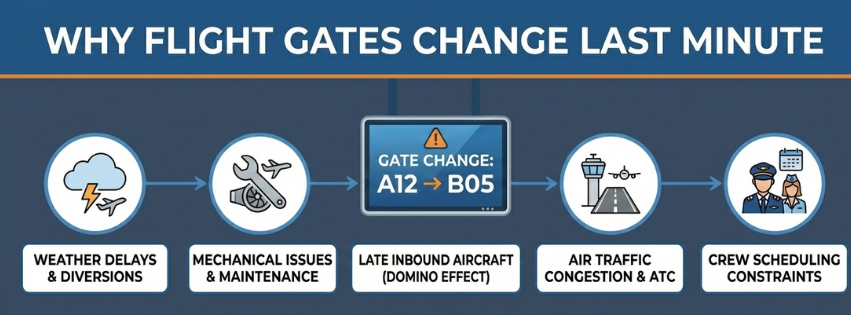
The Most Common Reasons for Last-Minute Gate Changes
1. Aircraft Delays and Schedule Adjustments
When an incoming aircraft is delayed, it creates a domino effect throughout the airport. Your plane might be arriving late from another city, which means it won't reach your departure gate on time. Rather than keep passengers waiting at one gate while blocking valuable space, airlines reassign your flight to an available gate where an aircraft is already ready or will arrive sooner.This shuffling helps keep the airport running efficiently, even if it means more walking for you.
2. Aircraft Maintenance Issues
Safety always comes first in aviation. If technicians discover a mechanical problem during pre-flight checks, the airline must either repair it or swap in a different aircraft. Since replacement planes might be parked at different gates—sometimes even different terminals—your departure gate changes accordingly.
These situations happen without much warning, which is why the gate change often feels so sudden.
3. Gate Availability and Traffic Congestion
Airports operate like busy highways, and gates are limited real estate. When flights run late or planes need extra time at a gate, it affects every flight scheduled after them. Airlines constantly juggle gate assignments to maximize efficiency.
Sometimes your gate gets reassigned because:
- A larger aircraft needs that specific gate for its size
- An international flight requires a gate with customs facilities
- Weather delays have caused backup across multiple gates
4. Bigger Aircraft or Equipment Swaps
Airlines occasionally swap aircraft based on demand. If your flight is oversold or another plane had issues, they might upgrade you to a larger aircraft. Bigger planes require specific gates equipped to handle their size and passenger capacity, which means moving your departure location.
While this can mean more legroom and seats, it also means a different gate.
5. Weather and Air Traffic Control Restrictions
Bad weather does not just delay flights—it changes how airports operate. During storms, certain runways or gates might close temporarily. Air traffic control may also reroute aircraft to different areas of the airport to manage congestion safely.
These decisions happen quickly and often result in multiple gate changes across the terminal.
6. Security or Operational Concerns
Occasionally, security issues, medical emergencies, or operational problems at a specific gate force airlines to relocate flights. While less common, these situations require immediate action and leave little time for advance notice.
How Last-Minute Gate Changes Affect Passengers
Gate changes create stress, especially if you have:
- Tight connections – Running from Gate A12 to Gate C47 with limited time
- Mobility challenges – Long walks or terminal changes become physically demanding
- Young children or elderly companions – Moving quickly becomes complicated
- No real-time updates – Missing the announcement means missing your flight
The key to managing gate changes is staying informed throughout your journey.
How to Stay Ahead of Gate Changes
Check Airport Monitors Regularly
Gate information can update multiple times before boarding. Make it a habit to glance at departure screens every 15-20 minutes, even after you have reached your gate.
Sign Up for Airline Notifications
Most airlines offer text or email alerts for gate changes. Enable these notifications when you book your flight or check in online.
Use a Reliable Flight Tracking App
This is where technology becomes your travel companion. Instead of constantly checking screens or waiting for announcements, a flight tracking app delivers updates directly to your phone.
FlyFi app, for example, provides real-time flight updates and instant alerts about gate changes, delays, and boarding times. It monitors your flight continuously and notifies you the moment something changes—giving you the extra minutes you need to navigate the airport calmly. Whether you're grabbing a meal or browsing a shop, you'll always know if your gate has moved.
Arrive at Your Gate Early
Even if boarding seems far away, get to your original gate with time to spare. This gives you a buffer if a gate change is announced and you need to relocate across the terminal.
Download Your Airline's App
Beyond third-party trackers, your airline's official app provides gate updates, boarding passes, and customer service options all in one place.
What to Do When Your Gate Changes
- Stay calm – Gate changes are routine and usually don't affect departure times significantly
- Check the new gate number carefully – Some terminals have similar-sounding gate numbers
- Ask airport staff if confused – They can point you in the right direction quickly
- Allow extra time for connections – Inform gate agents if you're cutting it close
The Bottom Line:
Last-minute gate changes are frustrating but usually unavoidable. They're the result of complex airport operations, weather conditions, aircraft logistics, and safety priorities. While you can't prevent them, you can definitely manage them better with preparation and the right tools.
By staying connected through real-time alerts—whether through airline notifications or a dedicated flight tracking app like FlyFi—you'll spend less time stressing and more time traveling smoothly. After all, flying should be about reaching your destination, not racing through terminals.
Safe travels, and may all your gates stay exactly where they're supposed to be!