Direct vs Connecting Flights: Which Saves More Money? (2026 Guide)
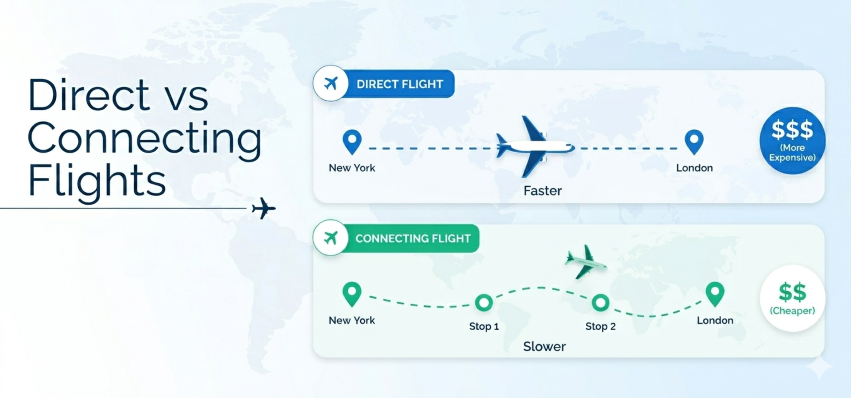
Direct flights are faster but cost 20–30% more. Connecting flights are cheaper and can save hundreds, especially on long-haul trips, but add time and risk. Choose direct for convenience, and connecting when savings are worth the extra travel time.
Published: April 21, 2026 Read Time: 8 minutes
Every time you search for a flight, you see two types of options — direct flights and connecting flights. The direct one is faster. The connecting one is cheaper. But is it always cheaper? And is the direct one always worth the extra cost?
In this guide, we break it all down simply. No complicated formulas. Just clear answers so you can book smarter in 2026.
What Is the Difference Between a Direct and Connecting Flight?
Before comparing prices, let's get the terms right.
Direct (Nonstop) Flight: You fly from your starting city to your destination without stopping. You board once, you land once. Done.
Connecting Flight: You fly from your city to a hub airport, get off the plane, then board a second (or third) flight to reach your destination.
One important thing: Always book connecting flights as a single ticket (one booking reference). If you book each leg separately and miss your second flight due to a delay, the airline owes you nothing. You buy a new ticket at full price.
How Much Cheaper Are Connecting Flights in 2026?
Here is the simple answer: connecting flights are usually 20–30% cheaper than direct flights on the same route.
| Route Type | Direct Flight Premium |
| Short-haul (under 3 hours) | 10–20% more expensive |
| Medium-haul (3–6 hours) | 15–25% more expensive |
| Long-haul (6–12 hours) | 20–30% more expensive |
| Ultra long-haul (12+ hours) | 25–40% more expensive |
| Peak season travel | Up to 50% more expensive |
Real Examples from 2026
- New York → Los Angeles: Direct costs $380–$450. Connecting costs $280–$320.
- London → New York: Direct costs $550–$750. Connecting via Dublin/Reykjavik costs $380–$480.
- Toronto → Tokyo: Direct costs $1,200–$1,600. Connecting via Seoul costs $820–$1,050.
- Mumbai → London: Direct costs $700–$950. Connecting via Dubai costs $480–$640.
- Family of four on a long-haul route: Connecting flights can save your family $600–$2,000 in one trip.
Why Are Connecting Flights Cheaper?
This confuses a lot of people. You are flying more distance on more planes — so why does it cost less?
1. Airlines charge extra for convenience. Business travelers pay more to avoid layovers. Airlines know this and price nonstops accordingly.
2. Hub airports fill empty seats. Airlines route passengers through hubs like Dubai, Frankfurt, or Atlanta. They discount connecting fares to fill those seats that would otherwise fly empty.
3. Gulf airlines changed the game. Emirates, Qatar Airways, and Etihad connect the whole world through Dubai and Doha. Their competition forces prices down on international routes. In 2026, they remain among the cheapest options for intercontinental travel.
4. Different countries tax flights differently. Routing through a low-tax country can lower your total fare even if the route is longer.
The Hidden Costs Nobody Talks About
Connecting flights look cheaper on the search page. But there are extra costs to factor in.
Hidden Costs of Connecting Flights
- Missing your connection: On a single ticket, the airline rebooks you for free. On separate tickets, you pay for a new flight — often $300–$800 at last-minute prices.
- Food at the airport: A 4-hour layover costs $25–$50 per person in meals and drinks. An overnight layover means a hotel: $80–$200 extra.
- Baggage on separate tickets: If you book two separate tickets, some airlines charge a full baggage fee on each leg.
- Stress and fatigue: This is harder to put a number on, but it is real — especially for families.
Hidden Costs of Direct Flights
Direct flights have their own fee traps in 2026:
- Basic Economy fares: Many direct flights are sold as Basic Economy, which excludes carry-on bags. That can add $31–$65 to your "cheap" nonstop.
- Seat selection: Airlines collected $4.2 billion in seat fees in 2024. A window seat on a long direct flight can cost $40–$120 extra.
- Peak-time surcharges: The most convenient morning and evening nonstops cost 10–15% more than the same route at an awkward time.
The rule: Always compare the full cost — ticket + bags + seat + realistic layover expenses — not just the base fare.
Baggage Fees in 2026: What You Need to Know
One big change happened in 2025: Southwest Airlines ended its "bags fly free" policy. They were the last major US airline to offer free checked bags. Now every major carrier charges.
| Airline | First Checked Bag | Carry-on (Budget) |
| Delta / United / American | $35–$40 | Usually included |
| Spirit / Frontier | $50+ (book online) | $31–$65 for overhead bin |
| Ryanair | Varies, strict enforcement | No free carry-on |
| Southwest (post-2025) | No longer free | One personal item free |
| Emirates / Qatar / Etihad | 30kg included in economy | Included |
Good news for connecting flights: If you book a single itinerary ticket, your bags transfer automatically and you pay the baggage fee only once. You do not pay again at each stop.
Time vs. Money: How to Make the Right Call
The best question to ask yourself before booking is this:
"How much is my time worth per hour?"
Here is the simple formula:
(Direct price − Connecting price) ÷ Extra hours added = Savings per hour
Example: The direct flight costs $450. The connecting flight costs $250. It adds 5 hours to your journey.
→ $200 ÷ 5 hours = $40 saved per hour of extra travel time
If your time is worth more than $40/hour — take the direct. If it is worth less — take the connection.
When Direct Flights Are Worth It
Choose a direct flight when:
- You are on a business trip and cannot afford to be late or tired
- You are travelling with young children — fewer boarding events makes a huge difference
- You are attending a wedding, medical appointment, or any time-critical event
- The route is short (under 3 hours) — the savings from a connection are too small to justify the extra time
- It is winter and you are flying through a storm-prone hub like Chicago or Denver
- You found a flash sale that brought the direct price close to the connecting price
When Connecting Flights Save You Real Money
Choose a connecting flight when:
- You are on a long-haul international route — this is where savings of $300–$500 per person are consistently available
- You are flexible with your schedule and not in a rush
- You are travelling as a family — multiply the per-person savings
- You are a student or budget traveller and $200 saved funds a week of accommodation
- Your layover is at a world-class airport like Singapore Changi, Dubai, or Istanbul — the stopover becomes an experience, not a burden
- You are flying an ultra-long route (14+ hours) — breaking it into segments is genuinely more comfortable for your body
The Best Airports for a Long Layover in 2026
Not all layovers are equal. These airports make a connection something to look forward to:
- Singapore Changi — cinema, rooftop pool, free city tour for 5.5+ hour layovers
- Doha Hamad — sleeping pods, spa, art installations by world-class artists
- Dubai International — luxury retail, restaurants from 50+ countries, connected to a city worth visiting
- Amsterdam Schiphol — Rijksmuseum mini-exhibition, casino, easy city access
- Istanbul — Turkish Airlines offers a free hotel stay and city tour for long layovers
Some airlines also offer free stopover programs — meaning your connection becomes a bonus free destination. Turkish Airlines, Icelandair, and Qatar Airways all run these. Worth checking before you book.
How to Book Cheap Flights in 2026: Timing That Works
The right timing can save as much as choosing between direct and connecting.
For domestic flights: Book around 39 days before departure. Google's 2026 data shows this is when average fares are lowest. Booking 1–3 months out saves up to 25% vs. last-minute prices.
For international flights: Book 3–5 months ahead. Set a price alert the day you fix your travel dates and book when it drops — not when you feel ready.
Best day to book: Sunday. International fares average 17% cheaper on Sundays vs. Fridays (Expedia 2025 Air Hacks Report).
Best days to fly: Tuesday, Wednesday, and Saturday. Mid-week fares are about 13% cheaper than weekends — roughly $100 off a typical ticket.
Best months to travel cheaply: Late August (crowds drop, prices drop), and shoulder seasons — January–February and September–October — where savings of 30–44% vs. peak summer are normal.
Simple Rules to Protect Yourself on Connecting Flights
- Always book one ticket, not two separate tickets. If anything goes wrong, the airline is responsible for getting you to your destination.
- Allow at least 90 minutes for domestic connections, 2.5–3 hours for international.
- Choose a hub with multiple daily flights to your destination. If you miss the connection, there is another one soon.
- Avoid winter connections through storm-prone hubs — Chicago, Denver, New York — if your schedule is tight.
- Pack essentials in your carry-on. If your checked bag is delayed, you can still function.
- Buy travel insurance for connecting itineraries. It costs $20–$80 and covers you if weather or delays force you to miss your flight.
The Verdict: Which Saves More Money in 2026?
Connecting flights save more on the ticket price — almost always.
But "cheapest ticket" is not the same as "cheapest trip." When you add bags, seat fees, airport food, and the real cost of a missed connection, the gap can narrow significantly.
The smartest approach for 2026:
- Long-haul trip? Take the connecting flight. Save $200–$500 per person. Book as a single ticket.
- Short-haul or time-sensitive? Take the direct. The savings do not justify the risk.
- Round trip with flexibility? Book direct outbound + connecting return. You arrive fresh when it matters, and save money on the way home.
That hybrid strategy is the single best tip in this article. Use it on your next booking.
Quick Reference: Direct vs Connecting at a Glance
| Factor | Direct Flight | Connecting Flight |
| Ticket price | 20–30% higher | Cheaper |
| Total journey time | Fastest | Adds 2–8 hours |
| Delay risk | Low | Moderate |
| Luggage risk | Very low | Higher |
| Best for families | Yes | No |
| Best for long-haul savings | No | Yes |
| Comfort on 14+ hr routes | Gruelling | Better |
| Miles/points value | Often better | Standard |
Sources: Expedia 2025 Air Hacks Report, Google Flights 2025–2026 Data, The Points Guy, Dollar Flight Club, National Geographic Travel, Booking.com Expert Insights.
Updated: April 2026