The Two-Brain System Behind FlyFi Flight Delay Predictions
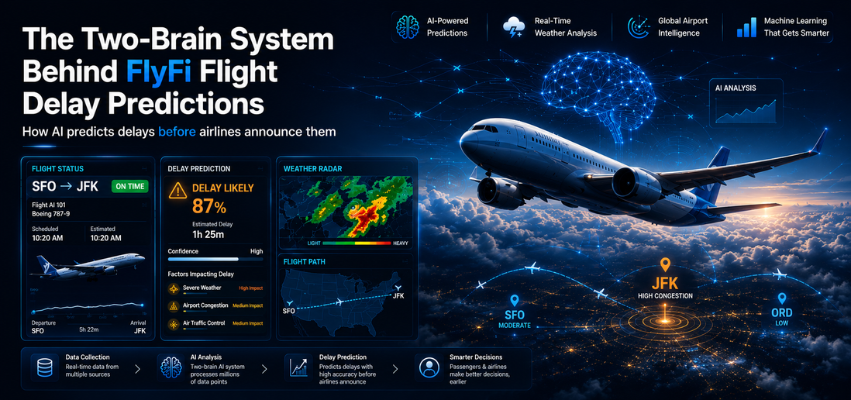
FlyFi uses two AI models — Vayu and Seer — to predict flight delays. Vayu processes messy flight data into stable patterns; Seer turns that into real-time, probability-based forecasts without relying on live weather feeds.
Most people assume flight delay prediction works like a weather forecast — plug in live data, run a calculation, get an answer. Clean and mechanical.
The reality of air travel is messier. And any system that treats it otherwise will eventually let you down at the worst possible moment.
FlyFi's AI flight delay prediction system was built around a different philosophy: accurate prediction requires two things working together — a strong logical foundation, and intelligent interpretation layered on top. That's the role of Vayu and Seer. Two models, one system, built for the genuine complexity of modern aviation.
Why Flight Delays Are So Hard to Predict
Flight delays rarely have a single cause. A late inbound aircraft, a crew nearing a rest limit, a slot restriction at the destination — each factor is manageable on its own. Together, they create a delay that looks sudden from the outside but had been building for hours.
Real-time data does not make it easier. Airline feeds are incomplete, inconsistent, and often lag behind what's actually happening on the ground. Prediction here isn't a lookup — it's a judgment call made with partial information, fast.
Where Traditional Prediction Systems Fall Short
Most delay forecast tools follow simple logic: weigh historical on-time rates against current weather, return a probability. That works in normal conditions — and breaks down exactly when it matters most.
When conditions are abnormal, historical averages mislead. And treating weather as a direct input creates fragility — a delayed feed, a storm's lingering network effects, or a carrier's operational response can all render the prediction useless.
That's the gap Vayu and Seer were built to fill.
Introducing the Dual-Model System: Vayu and Seer
FlyFi's AI flight delay prediction system is built on two complementary models that handle different parts of the prediction problem.
Vayu is the foundation — a reasoning engine that processes raw, often incomplete flight data and extracts stable behavioral patterns. It doesn't get thrown by missing fields or inconsistent sources. Its job is to build reliable logical ground from unreliable inputs.
Seer is the intelligence layer — a prediction engine that takes Vayu's structured understanding and interprets it through real-world context: airline behavior, route-specific patterns, timing, and probability.
The relationship is direct: Vayu builds the logic. Seer delivers the prediction.
Vayu: The Reasoning Engine
Vayu's core strength is stability under uncertainty. Aviation data in the real world is noisy — feeds drop out, timestamps conflict, carrier reporting varies by region. Most models either wait for clean data or fail quietly when it's absent. Vayu works through it.
It analyzes flight behavior across thousands of routes — not to find the average, but to understand the underlying mechanics. How does delay propagate through a specific hub? How does a carrier typically respond when its inbound aircraft is late? What does a 15-minute deviation early in the day usually mean for the evening's schedule?
Vayu does not predict these patterns directly. It builds a structured, stable representation of operational reality — one that Seer reasons on top of.
Seer: The Prediction Engine
Where Vayu works at the level of patterns and logic, Seer works at the level of meaning. It takes Vayu's structured output and asks: given what we know about how this airline behaves on this route, at this time, what is most likely to happen?
Seer's predictions are not binary. Rather than "on time" or "delayed," it generates probability distributions — a traveler might see a 74% chance of departing within 10 minutes of schedule, a 19% chance of a 20–45 minute delay, and a smaller tail risk beyond that. More honest, and more useful, than a single-word answer.
Seer also updates continuously. As gate changes, inbound aircraft status, and crew assignments come in, it revises. The closer to departure, the sharper the prediction becomes.
How Vayu and Seer Work Together
The two models operate as a pipeline. Vayu processes the incoming data stream — fragmented, inconsistent, real-world — and produces a stable behavioral model of the flight and its network context. Seer receives that output and generates the prediction.
Neither works as well alone. Seer without Vayu is building predictions on shaky data. Vayu without Seer produces rich pattern analysis with no mechanism to make it actionable. Together, they cover the full prediction problem.
How the System Handles Weather — Without Depending on It
Most prediction tools break when a weather feed is delayed or a forecast misses. FlyFi's system is built differently — here's how:
❌ What it doesn't do
- Pull live weather data as a direct input
- Raise or lower predictions based on weather forecasts
✅ What it does instead
- Trains on roughly 10 days of recent flight behavior alongside longer historical patterns
- Every storm, fog event, or disruption is already encoded in how flights actually responded
- Every storm, fog event, or disruption is already encoded in how flights actually responded
Why this matters
- Weather feed delayed? The system still works
- Forecasted storm that misses its mark? No overcorrection
- Responds to what airlines actually do — which is what determines your delay, not the forecast
In short: The system does not predict weather. It recognizes what weather-impacted operations look like — and that's a more reliable signal.
Real-World Benefits for Travelers and Aviation Teams
For travelers, the practical difference shows up in timing. Knowing a delay is likely an hour or two before it's announced changes what you can do — explore rebooking options while inventory is still available, adjust pickup plans, make a call before the situation forces one on you.
For travel managers and operations teams, Seer's probability outputs provide something more structured than gut feel. Routes with persistently elevated delay risk can be flagged. Carrier-specific patterns can inform booking policy. The behavioral intelligence Vayu accumulates becomes an ongoing operational asset.
Built in the US, Now Operating Globally
Vayu and Seer were originally developed and validated against US domestic aviation — a market combining high volume, diverse carrier types, and frequent weather variability. It was the right environment to stress-test both models.
That foundation now underpins global coverage, extended to major carriers across Europe, Asia-Pacific, Latin America, and beyond. The core logic holds across markets: airlines have learnable operational signatures, and delays have recognizable patterns regardless of geography.
Whether you are tracking a flight through Heathrow, Singapore Changi, or O'Hare, the same system is working in the background inside FlyFi.
A Simple Way to Understand the System
FlyFi app uses two AI models — Vayu and Seer — that work together to predict flight delays. Vayu processes raw, often messy flight data to find stable behavioral patterns in how airlines operate. Seer takes that foundation and generates probability-based predictions, adapting in real time as new information arrives.
Rather than relying on live weather data, the system learns from observed flight behavior, which naturally captures the impact of weather and other disruptions. The result is a flight delay forecast that reflects how aviation actually works.
Frequently Asked Questions
How does FlyFi's AI flight prediction system work?
It uses two models in sequence. Vayu analyzes flight data to extract behavioral patterns from incomplete or messy inputs. Seer uses that structured output to generate probability-based delay predictions, updating them continuously as conditions change.
Why is predicting flight delays so difficult?
Delays are almost always the result of multiple interacting factors — late inbound aircraft, crew constraints, slot restrictions, cascading network effects. No single data point captures this, and real-time airline data is often incomplete or inconsistent.
Does the system use weather data?
Not directly in a traditional sense. Instead, it learns from historical patterns where weather and other variables have already influenced flight outcomes.
Does the system work for international routes?
Yes. Originally validated on US domestic aviation, the system now covers major international carriers and hubs across Europe, Asia-Pacific, and Latin America.
Prediction Built for the Real World
The delays that matter most — the ones that cascade and compound — are exactly the ones simple tools miss.
Vayu brings stability to messy data. Seer brings intelligence to uncertain situations. Together, they give travelers something the industry has rarely offered — a forecast that reflects how air travel actually behaves, right inside FlyFi's flight tracker.
Not a guarantee. Not a guess. Something you can actually plan around.