Last updated November 25, 2026
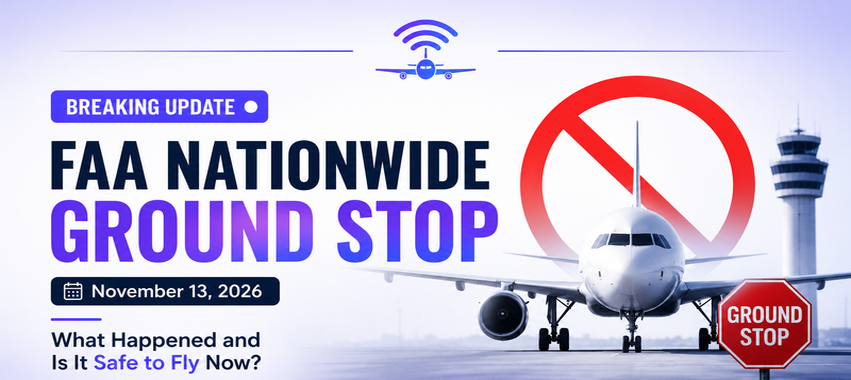
A communications failure in the FAA's air traffic control network forced a nationwide ground stop on Friday, November 13, 2026. Departures at every U.S. airport were held for about four hours. The FAA lifted the order at 8:15 p.m. ET that night. The FAA and Transportation Secretary Sean Duffy say it is safe to fly, and most major airlines were close to normal schedules by Monday, November 16. The final cause has not been announced.
Quick facts
| Date | Friday, November 13, 2026 |
| Duration | A little over 4 hours (lifted 8:15 p.m. ET) |
| Still active? | No |
| Cause (so far) | Overloaded older telecom equipment; FAA and L3Harris investigating |
| Cyberattack? | FAA says no evidence |
| Planes in the air | About 3,500, all landed safely (FAA) |
| Safe to fly? | Yes, per the FAA |
| Back to normal? | Mostly by Monday, Nov. 16 |
What happened on November 13, 2026?
The FAA says it hit a technical problem at about 3:30 p.m. ET. Duffy put the first instability at 3:36 p.m. The ground stop followed shortly before 4 p.m.
The advisory said all departures were halted "due to extraordinary circumstances and for reasons of safety." Flights already airborne were handled case by case. International flights were also handled case by case, and some transatlantic departures from Boston were allowed to leave.
Frequencies stayed available to land commercial aircraft. Life-saving, law enforcement and military flights were not affected. Bedford called it the nation's longest ground stop in 25 years. AP described it as the second nationwide ground stop of all departures since September 11, after the January 2023 NOTAM outage.
Timeline (all times ET)
| Time | Event |
| Fri, ~3:30 p.m. | FAA reports a technical problem |
| Fri, 3:36 p.m. | Duffy says instability was detected |
| Fri, just before 4 p.m. | Nationwide ground stop ordered |
| Fri, 7:05 p.m. | Cirium counts 827 diversions or returns |
| Fri, 8:15 p.m. | Ground stop lifted |
| Sat, Nov. 14 | Duffy says "it is safe to fly"; 3,800+ cancellations |
| Sun, Nov. 15 | Nearly 2,300 cancellations; FAA targets normal schedules by end of day |
| Mon, Nov. 16 | Most major airlines at or near normal |
What is a ground stop?
A ground stop is an FAA order that keeps aircraft on the ground at one or more airports. Planes already flying keep going. It's used when the FAA can't guarantee that controllers and pilots can communicate reliably.
It is different from a ground delay. In a ground delay, flights still depart but are held at the gate and released at assigned times to manage congestion. In a ground stop, nothing leaves until the order is lifted.
Why did the FAA issue the nationwide ground stop?
According to the FAA, older equipment on its telecommunications network became unstable when it was flooded with data. The agency said it saw roughly 1,000 connection attempts every four to five seconds. That disrupted the links that carry radio and radar information between facilities.
The instability hit 17 of the FAA's 22 en route air traffic control centers and spread to several approach control facilities. Bedford said none of the facilities "actually went dark." Some radar feeds and radio frequencies kept working, which is why controllers could still land the planes in the air.
The FAA pointed to two sites as the likely sources: a radar site in Amarillo, Texas, and a radio site in El Dorado, Arkansas. Contractor L3Harris was installing a new router at El Dorado. Duffy said the contractor was switching old copper lines to fiber while replacing that router, and the router then flooded others with data. Investigators haven't said whether it was a contractor error or faulty equipment.
Some things have been ruled out:
- Cyberattack: The FAA says it has no evidence of one. Homeland Security Secretary Markwayne Mullin called it a telecommunications outage.
- The new SMART airspace tool: The FAA says it is unrelated, and its vendor, Air Space Intelligence, said the same.
The work was routine maintenance done midday at a remote facility. It is normally done at night. The FAA says it will review that timing.
Which airports, airlines, and flights were affected?
Every U.S. departure was held, so no region was spared. Some places recovered more slowly.
Airports named in reports
- Chicago O'Hare: about 11% of scheduled Saturday morning departures canceled by mid-morning. Midway had 25 cancellations.
- Boston, Atlanta, Miami, Pittsburgh, the New York area, Los Angeles and Baltimore: delays were still possible on Saturday, per CBS.
Airlines. Delta, United, American and Southwest all announced waivers or flexible rebooking. Cargo flights were delayed too.
Flights and passengers. Cirium counted about 11,000 flights and more than 1.5 million passengers scheduled after the stop began. By 7:05 p.m. ET it had logged 827 diversions or returns: 670 flights turned back and 157 landed elsewhere. Duffy said tens of thousands of passengers were stranded.
How many flights were delayed or canceled?
Counts differ by source and time window. Trackers define cancellations differently, and the totals were still moving that night.
| Source | Window | Cancelled | Delayed |
| FlightAware (via CBS) | Friday | ~9,100 | ~7,200 |
| FlightRadar24 (via Al Jazeera) | Friday | 4,700+ | ~10,000 |
| FlightAware | Saturday | 3,800+ | ~2,000 |
| ABC7 | Sunday | ~2,300 | n/a |
| FAA Q&A page | Whole episode | ~12,462 (not all directly caused by the stop) | n/a |
| FAA estimate cited by Gray DC | Whole episode | ~18,000 | ~28,000 |
If you need one number, say "thousands of flights over several days." The FAA's own figures run from about 12,500 to about 18,000 cancellations, depending on the source.
Is it safe to fly in the US right now?
The FAA says yes. Its Q&A states the safety of the system was not compromised. Duffy said on Saturday "it is safe to fly," and Bedford said "the worst is behind us."
The ground stop itself was a safety measure. The agency didn't want to launch more planes into a network it couldn't trust, and the planes already flying landed safely.
Since then, the FAA says it has:
- Disabled the functionality of the router that started the problem.
- Disabled the same functionality on more than 60 similar routers.
- Paused new router installs.
- Blocked the two suspected sites from flooding the network.
Some questions are still open. The root cause is not final, and outside experts have asked why one router swap could ripple this far. Duffy has warned that similar failures could recur without major upgrades, and he is asking Congress for $50 billion to modernize the system. That is a warning about the long-term state of the network, not a sign that flying is unsafe today.
Has normal flight operation resumed?
Mostly, yes. Bedford said schedules should be back to normal by the end of Sunday, November 15. By Monday, most major airlines were at or near normal.
United had a separate technology issue on November 16 that affected departures. It was resolved the same day, and nothing in the reporting links it to the FAA's network.
Thanksgiving is the next test. AAA expects about 81 million people to travel, close to 6 million by air. Duffy has said he expects operations to be fully up and running for the holiday peak. Ordinary weather delays are a separate matter and can still happen.
For live conditions at any airport, check the FAA's National Airspace System status page at nasstatus.faa.gov.
What should passengers do if their flights are affected?
Start with the airline's app, not the airport counter. Rebooking options often show up there before an agent can help.
Airline waivers
| Airline | What was announced |
| United | No change fees or fare difference; rebook onto United flights through Nov. 20 |
| Delta | Free changes for Friday and Saturday flights |
| American | Change and cancel fees waived |
| Southwest | Waivers and free rebooking |
Most of these windows are closing or have closed. Check your airline's current policy before relying on them.
Refund vs. compensation
These are different things.
Refund. Under U.S. Department of Transportation rules, if your flight is canceled and you decline the rebooking or credit offered, you're owed a refund, whatever the reason for the cancellation. Airlines must refund automatically: within seven business days for credit card payments, and within 20 calendar days for other payment types. Don't cancel the ticket yourself before the airline does, because that can complicate the refund.
Compensation. Federal rules don't require airlines to pay for hotels, meals or cash compensation when the disruption is outside their control. Some airlines offer help voluntarily, so check your airline's customer service commitments. Some credit cards also include trip delay coverage.
Keep receipts for any hotel, meal or ride you paid for because of the delay.
How can travelers check live flight status?
Your airline's app and the airport's departure board are the most direct sources. The FAA's nasstatus.faa.gov shows airport-level delays and ground stops.
FlyFi's live flight tracker shows where a plane actually is. You enter the airline, flight number and date, and it shows the aircraft's live position, plus status, gate and terminal information. It also offers delay alerts and predictions. That helps on a day like this one, because your flight can be late because the inbound plane is late.
Frequently asked questions
Is the FAA ground stop still in effect?
No. The FAA lifted the nationwide ground stop at 8:15 p.m. ET on November 13, 2026. Local ground stops can still be issued for weather or other airport problems.
What caused the FAA nationwide ground stop?
Older telecom equipment became unstable when flooded with data. The FAA suspects sites in Amarillo, Texas and El Dorado, Arkansas, where contractor L3Harris was working on a router. The final cause is still under investigation.
Was it a cyberattack?
The FAA says it has no evidence of one. Homeland Security Secretary Markwayne Mullin called it a telecommunications outage.
How long did the ground stop last?
A little over four hours, from shortly before 4 p.m. ET to 8:15 p.m. Some reports count more than five hours when they start at the first signs of trouble around 3:30 p.m.
Were any planes in danger?
The FAA says about 3,500 aircraft were airborne when the order came, and every one landed safely.
How many flights were canceled?
It depends on the source and the window. For Friday alone, trackers showed roughly 4,700 to 9,100 cancellations. For the whole episode, the FAA's Q&A cites about 12,462, and other outlets citing FAA estimates say about 18,000.
Can I get a refund for a canceled flight?
Yes, if the airline canceled your flight and you decline the alternative it offers. Refunds are owed regardless of the cause.
Will the airline pay for my hotel or meals?
Federal rules don't require it when the disruption is outside the airline's control. Some airlines help voluntarily, so ask.
Will this happen again?
Nobody can promise it won't. The FAA has disabled the equipment function involved and paused installs. The investigation continues, and officials say the network needs modernizing.
Is it safe to fly over Thanksgiving?
The FAA and the Transportation Secretary say the system is safe, and officials expect normal operations for the holiday. Check your flight status before leaving for the airport.
Sources:
- FAA Q&A
- Al Jazeera explainer
- Al Jazeera, flights resume
- AP via Cleveland19
- Weather.com
- WTTW
- Chicago Sun-Times
- CBS via Yahoo
- ABC13
- Gray DC via WCAX
- U.S. DOT refund rule